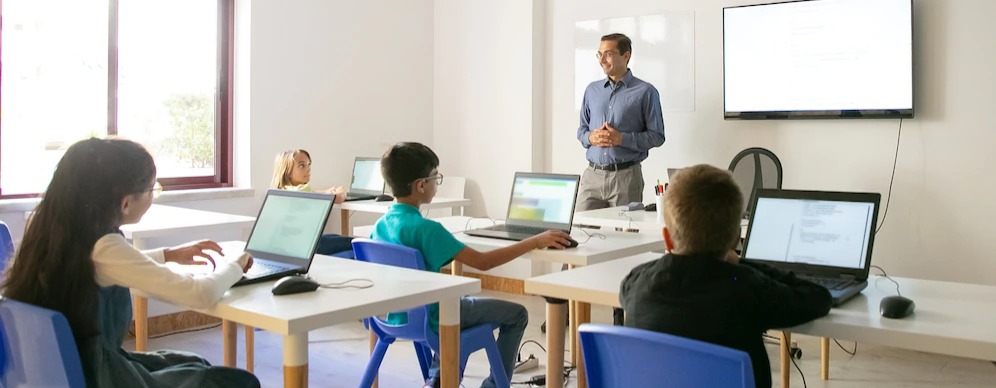
Education software refers to computer programs and applications whose direct purpose is teaching or self-learning. However, technological innovations have upgraded modern education software to the point that it can deliver most, if not all, tasks associated with the classroom experience.
Who Uses Educational Software?
Aside from students, the most common users of education software are teachers, parents, and school administrators.
School administrators and teachers utilize the software to create educational content, share lessons and other course-relate information, manage virtual classrooms, and store all school-related data.
Moreover, the software helps parents ensure that their children get the learning experience they deserve while monitoring their academic performance.
What Are the Benefits Of Educational Software?
Educational software brings several advantages to students, school administrators, and teachers. Here are some of the most common benefits of these educational tools:
- Easy Content Organization and Accessibility
Teachers can create and store academic materials in educational software. Software like learning management systems (LMS) often have sizable storage spaces for storing high volumes of course information and learning programs.
Furthermore, a cloud-based LMS makes the content much more accessible for all school administrators, making it easier to collaborate and cross-check information gaps between subjects and lessons.
- Monitoring Student Performance And Behavior
Another essential function of education software is monitoring, recording, and reporting each student's performance. This feature helps teachers understand how much of the subject the students understand or find challenging, allowing them to make the necessary adjustments to improve the program's content to suit the student's needs.
Education software allows teachers to create personalized content, which is ideal when targeting the improvement of a particular learner. The software also generates reports for the students and their parents for transparency.
- Reduced Costs
Schools can reduce operational costs by going online for specific courses. School administrators can save on rent, learning materials, and utility expenses through remote learning without compromising the student's quality of education.
- More Manageable Workloads for Teachers
Teaching is a challenging profession. Fortunately, education software can automate several functions of secondary importance, allowing teachers to focus on higher-priority tasks. For example, special tools can collect student information, grade homework, generate and check exams, and take care of other time-consuming assignments.
- Improves Student Engagement
Keeping a student's attention is challenging and gets more complicated when the learning setting is removed from the school. Teachers must get creative and prepare stimulating courses that are effective when launched through educational software. Out-of-the-box tasks tend to keep students engaged and motivated longer.
Since gadgets and computers usually distract students, teachers must consider how to deal with them when creating learning programs. Some software features cutting-edge technologies like AI, AR, and VR, guaranteed to excite students and get their attention. However, some solutions are more basic, requiring gamification and diverse activities to gain the student's interest.
Conclusion
Technology has revolutionized the educational sector in more ways than one. The development of educational software helps improve student education even if they are at home, regardless of their age or level.
It's an excellent strategy to promote accessibility and education since students can learn new information at any time and place, as long as they have a computer or smartphone and an internet connection.