This website uses cookies
We use cookies to personalise content and ads, to provide social media features and to analyse our traffic. We also share information about your use of our site with our social media, advertising and analytics partners who may combine it with other information that you’ve provided to them or that they’ve collected from your use of their services.
Consent Selection
Details
  • Necessary cookies help make a website usable by enabling basic functions like page navigation and access to secure areas of the website. The website cannot function properly without these cookies.
    • Learn more about this provideropens in a new window
      CookieConsentStores the user's cookie consent state for the current domain
      Maximum Storage Duration: 1 yearType: HTTP Cookie
    • Learn more about this provideropens in a new window

      Some of the data collected by this provider is for the purposes of personalization and measuring advertising effectiveness. The provider may use the IP Addresses for ads measurement and ads personalization.

      rc::aThis cookie is used to distinguish between humans and bots. This is beneficial for the website, in order to make valid reports on the use of their website.
      Maximum Storage Duration: PersistentType: HTML Local Storage
      rc::cThis cookie is used to distinguish between humans and bots.
      Maximum Storage Duration: SessionType: HTML Local Storage
    • Learn more about this provideropens in a new window
      __cf_bmThis cookie is used to distinguish between humans and bots. This is beneficial for the website, in order to make valid reports on the use of their website.
      Maximum Storage Duration: 1 dayType: HTTP Cookie
      bcookieUsed in order to detect spam and improve the website's security.
      Maximum Storage Duration: 1 yearType: HTTP Cookie
      li_gcStores the user's cookie consent state for the current domain
      Maximum Storage Duration: 180 daysType: HTTP Cookie
  • Preference cookies enable a website to remember information that changes the way the website behaves or looks, like your preferred language or the region that you are in.
    • Learn more about this provideropens in a new window
      lidcRegisters which server-cluster is serving the visitor. This is used in context with load balancing, in order to optimize user experience.
      Maximum Storage Duration: 1 dayType: HTTP Cookie
  • Statistic cookies help website owners to understand how visitors interact with websites by collecting and reporting information anonymously.
    • Learn more about this provideropens in a new window

      Some of the data collected by this provider is for the purposes of personalization and measuring advertising effectiveness. The provider may use the IP Addresses for ads measurement and ads personalization.

      _gaUsed to send data to Google Analytics about the visitor's device and behavior. Tracks the visitor across devices and marketing channels.
      Maximum Storage Duration: 2 yearsType: HTTP Cookie
      _ga_#Used to send data to Google Analytics about the visitor's device and behavior. Tracks the visitor across devices and marketing channels.
      Maximum Storage Duration: 2 yearsType: HTTP Cookie
    • _gat [x2]Used to send data to Google Analytics about the visitor's device and behavior. Tracks the visitor across devices and marketing channels.
      Maximum Storage Duration: 1 dayType: HTTP Cookie
  • Marketing cookies are used to track visitors across websites. The intention is to display ads that are relevant and engaging for the individual user and thereby more valuable for publishers and third party advertisers.
    • Learn more about this provideropens in a new window

      Some of the data collected by this provider is for the purposes of personalization and measuring advertising effectiveness. The provider may use the IP Addresses for ads measurement and ads personalization.

      _gidUsed to send data to Google Analytics about the visitor's device and behavior. Tracks the visitor across devices and marketing channels.
      Maximum Storage Duration: 1 dayType: HTTP Cookie
    • Learn more about this provideropens in a new window
      __Secure-ROLLOUT_TOKENUsed to track user’s interaction with embedded content.
      Maximum Storage Duration: 180 daysType: HTTP Cookie
      __Secure-YECStores the user's video player preferences using embedded YouTube video
      Maximum Storage Duration: SessionType: HTTP Cookie
      __Secure-YNIDUsed to track user’s interaction with embedded content.
      Maximum Storage Duration: 180 daysType: HTTP Cookie
      LAST_RESULT_ENTRY_KEYUsed to track user’s interaction with embedded content.
      Maximum Storage Duration: SessionType: HTTP Cookie
      LogsDatabaseV2:V#||LogsRequestsStoreUsed to track user’s interaction with embedded content.
      Maximum Storage Duration: PersistentType: IndexedDB
      TESTCOOKIESENABLEDUsed to track user’s interaction with embedded content.
      Maximum Storage Duration: 1 dayType: HTTP Cookie
      VISITOR_INFO1_LIVETries to estimate the users' bandwidth on pages with integrated YouTube videos.
      Maximum Storage Duration: 180 daysType: HTTP Cookie
      YSCRegisters a unique ID to keep statistics of what videos from YouTube the user has seen.
      Maximum Storage Duration: SessionType: HTTP Cookie
      yt-icons-last-purgedNecessary for the implementation and functionality of YouTube video-content on the website.
      Maximum Storage Duration: PersistentType: HTML Local Storage
      YtIdbMeta#databasesUsed to track user’s interaction with embedded content.
      Maximum Storage Duration: PersistentType: IndexedDB
  • Unclassified cookies are cookies that we are in the process of classifying, together with the providers of individual cookies.
    • We do not use cookies of this type.

Cookie declaration last updated on 8/14/26 by Cookiebot
[#IABV2_TITLE#]
[#IABV2_BODY_INTRO#]
[#IABV2_BODY_LEGITIMATE_INTEREST_INTRO#]
[#IABV2_BODY_PREFERENCE_INTRO#]
[#IABV2_BODY_PURPOSES_INTRO#]
[#IABV2_BODY_PURPOSES#]
[#IABV2_BODY_FEATURES_INTRO#]
[#IABV2_BODY_FEATURES#]
[#IABV2_BODY_PARTNERS_INTRO#]
[#IABV2_BODY_PARTNERS#]
About
Cookies are small text files that can be used by websites to make a user's experience more efficient.

The law states that we can store cookies on your device if they are strictly necessary for the operation of this site. For all other types of cookies we need your permission.

This site uses different types of cookies. Some cookies are placed by third party services that appear on our pages.

You can at any time change or withdraw your consent from the Cookie Declaration on our website.

Learn more about who we are, how you can contact us and how we process personal data in our Privacy Policy.

Please state your consent ID and date when you contact us regarding your consent.
A Learner's Guide to Virtual Reality in Science and Education

Virtual Reality (VR) has evolved beyond its initial entertainment applications, becoming a transformative force in science and education. Modern organizations have combined VR with Augmented Reality (AR) to facilitate collaborative learning experiences, allowing learners to connect in virtual learning environments regardless of physical location.

Moreover, VR has become vital in many educational and training applications. Immersive virtual classrooms and training simulations have proven extremely valuable in providing an effective learning experience. The educational technology is also flexible enough to cater to different learning styles and preferences, from visual-heavy presentations to hands-on or computer-generated activities.

Businesses and learning institutions must be eager to explore VR and better understand its profound impact on students and trainees, especially in scientific exploration and educational experiences.

What Is Virtual Reality?

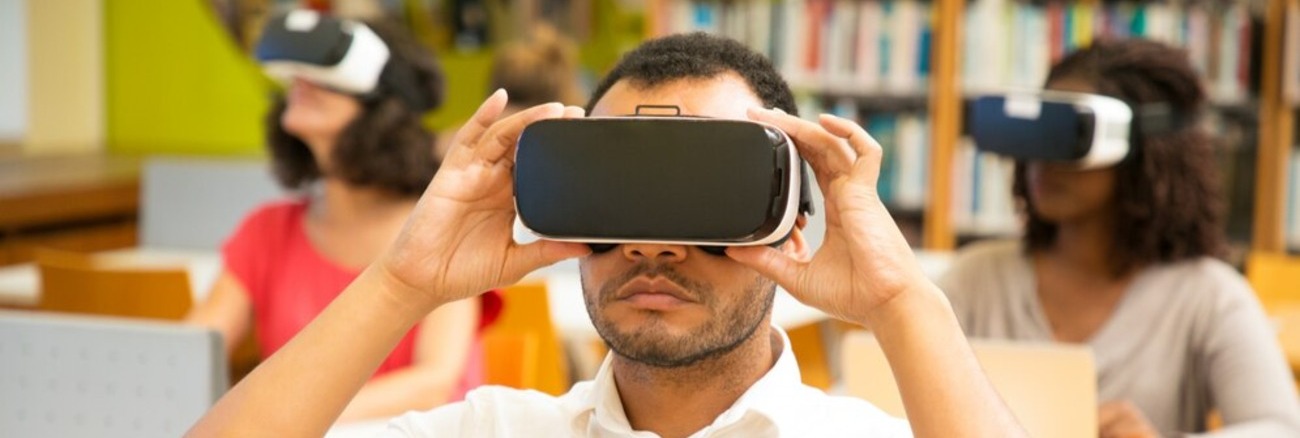
Virtual Reality (VR) is a technology that immerses users in computer-generated environments, creating a sensory experience. Essential components include headsets, controllers, sensors, and computing devices, working harmoniously to deliver a fully immersive encounter.

Distinguishing between Virtual Reality (VR) and Augmented Reality (AR) is crucial. While VR immerses users entirely in virtual environments, AR only overlays digital content in the real-world setting. Mixed Reality (MR) combines elements of both, providing a seamless blend of virtual and physical realities.

Virtual Reality in Science

Virtual Laboratories

VR revolutionizes traditional laboratories by enabling students to conduct experiments in a risk-free virtual space. This not only enhances safety but also deepens understanding through interactive learning experiences.

Additionally, it allows organizations to reduce costs by avoiding purchasing pricey equipment and other necessary components for actual experiments.

Medical Training

Medical professionals benefit from VR through realistic surgical simulations and 3D explorations of anatomical models. This technology is especially beneficial in high-risk sectors like healthcare, where making mistakes can lead to disastrous outcomes for everyone involved.

Since the simulations do not involve actual patients, trainees can focus more on learning what to do, leading to improved student learning outcomes.

Astronomy Exploration

VR facilitates interactive space exploration by transporting users to celestial realms. Complex astronomical concepts become more accessible through visualizations and immersive experiences.

Moreover, holding simulations in VR is completely secure because users can control multiple factors they usually could not in real-world applications. For example, flight simulators help students learn how to manage different mishaps during aviation, improving their experience and real-time preparedness without risking their safety.

Virtual Reality in Education

Virtual Field Trips

VR technology allows students to embark on virtual field trips to historical sites, museums, and natural wonders, transcending geographical constraints while making education more inclusive.

Language Learning

Language learners can engage in immersive language practice within realistic scenarios created by VR. Cultural exposure becomes an integral part of language education through virtual environments.

Historical Reconstructions

Historical events can be brought to life through VR's recreation of past environments, enabling students to interact with and become captivated by these occurrences.

Common Challenges With ARVR

1. High Costs

A significant obstacle to using VR is the financial aspect of the technology. Creating top-notch VR content can be costly, and not every educational institution or company might have the financial resources to invest in these technologies.

2. Technical Skill Requirements

AR and VR require advanced technical skills to develop and maintain complex systems. Like other communications technologies, AR and VR applications can be prone to technical issues such as hardware malfunctions or connectivity problems.

Without skilled employees manning the platforms, relying on ARVR can disrupt the learning experience instead of improving it.

3. Health Concerns

Due to its high graphics resolution, prolonged VR usage may lead to health and safety risks like migraines, vertigo, and visual fatigue. It is crucial to periodically rest and restrict the use of these technologies to avoid these problems.

Future Trends and Developments

VR in Remote Learning

VR supports remote learning possibilities by enabling students to access educational resources and simulations from any location globally. This flexible trait is valuable when students cannot attend face-to-face training sessions.

If VR learning is executed properly, students can feel like they are only playing a video game while ending up performing masterfully both in the virtual and real worlds. The more comfortable they can be with the VR setting, the better their learning achievements will be.

Advancements in Interactivity

One of the biggest challenges of the learning process is keeping students engaged and motivated. Organizations can utilize the digital elements of VR to create an enhanced interactive experience that can better attract and retain learners' attention.

Furthermore, recent studies show that immersive VR technologies can significantly boost the ability to retain and recall information.

A Final Word on Learning With ARVR

Using VR technologies in learning has many advantages. It makes subjects more enjoyable and helps students remember information better. It also allows for realistic practice while enabling learning from anywhere.

As more institutions demonstrate the effectiveness of VR in learning, it becomes clearer that it will play an increasingly important role in the future of education and science. Given its capacity to revolutionize our training and development methods, it is pretty understandable that VR is gaining growing popularity in the learning field.